Tuesday, January 20, 2009

Yes, Another Study Demonstrating That HC Costs are Still on the Rise

Towers Perrin, an HR consulting Firm just released their annual HC Cost Survey for 2009. And while it seems that there is a similar study released every week, all of them telling us what we already know, the Towers HC Cost Report is widely used and respected in the industry.


The new data suggests that employers will pay, on average, $9,552 per employee for health benefits in 2009, a jump of 6% from 2008. Yet some employers will buck the trend because they proactively manage their benefit programs.

One interesting nugget of data reveals that "high-performing companies," or those organizations that rigorously track their health benefit objectives, will spend on average, 12% less in annual health care premiums in 2009, compared to low-performing companies. For example, high-performing firms report health benefits costs $8,904 per employee, compared to $10,104 for low-performing companies. The cost fell even lower (to $7,032) at high-performing companies utilizing consumer-driven health plans with health savings accounts. (Still not convinced about CDHP?)

The survey defined high performers as companies that not only had a strong commitment to improving employee health and engagement, but also aggressively managed their health plans and the delivery process.

Other Findings Within The Study:

  • Large employers are experiencing health care cost increases of 6% on average, or $532 per employee per year. Although this year's average percentage increase is similar to last year's, employers are paying 29% more today than they spent five years ago for health care.

  • In flat dollar terms, the employee share in 2009 will average $80 per month ($960 annually) for employee-only coverage and $273 per month ($3,276 annually) for family coverage - a significant cost for many employees.

  • Pre-65 retirees will contribute approximately 51% of the premium for retiree-only coverage, and 54% for family coverage.

  • Retirees age 65 and older will pay an average of $148 per month (or $1,776 annually) for retiree-only coverage and $309 per month (or $3,708 annually) to add coverage for one dependent.

Follow the link above to read the study for yourself.

-JS

Friday, January 16, 2009

What is "Trend?" And How Much of It is Price Margin?

One of the major components of premium or rates that insurers use on commercial accounts is called Medical Trend. Loosely defined, Annual Medical Trend is the historical or projected average change per year in an insurers medical, capitation, and pharmacy costs. In the last quarter of 2008, average HMO and PPO annual trends ran between 10-12%. On different cases that I've brokered I've seen trend as high as 17%.
Certainly there is justification for trend increases year over year. New technology and infrastructure in the HC system, pharmacy costs, aging workforce, Medicare reimbursement rates, so on and so forth. But new data shows that the Medical CPI is actually leveling off, and in some cases, declining.
I really have to learn how to upload better graphs from Excel sheets, but the graph below displays the Medical CPI for the last ten years. (Trust me, the data is in there.) Year Over Year (YOY) Medical CPI appears to be flat or declining. I have the rest of the data that shows that this is relevant across inpatient, outpatient and medical services. However, the Producer Price Index ( PPI ) which is the carrier's premium pricing in aggregate is going up 7bps over November and close to 3/4% YOY. It suggests that while the insurance carriers affordability efforts are containing trend, the increased trends that groups are receiving are more an effort for the carrier's margin expansion than it is a legitimate effort to price to a rising trend.
Admittedly, less than a percent is not a lot, but compounded YOY it can be.

-JS

Thursday, January 15, 2009

A New Stage Is Set for Health Care Reform

It's long, but there's a great article from by Bill Leonard on SHRM's website that explicates some of Senator Daschle's key points from his new book, "Critical: What We Can Do About the Health-Care Crisis." Scroll down to the section Fundamental Shift for the meat of the article. . .

Here's the transcript:

A New Stage Is Set for Health Care Reform
By Bill Leonard

What kind of health care system will President Obama and congressional Democrats pursue?

While both promise to bring new thinking and ideas to the debate, indications are that the administration wants to find ways to “strengthen” the current employer-based system rather than work to phase out that connection, which forms the basis of the health care system most Americans have known for generations. And while the idea of a federal health board has been floated by former Senator Tom Daschle, Obama’s nominee for secretary of Health and Human Services, that could be a tough sell given the specter of big government that doomed a health care reform package during the Clinton administration.

In a new book, Daschle envisions a panel similar to the Federal Reserve Board that would create a single standard of health care for the nation and exert influence on prices and health care costs for health care providers and insurance vendors.

Obama and his transition team have praised Daschle for bringing new ideas to the debate, but they haven’t completely endorsed the federal health board idea, sources say. The incoming administration’s approach has been measured and moderate.

Another potentially dramatic shift in national health care policy being discussed could resemble the “pay or play” systems passed in states such as Massachusetts and Vermont, where employers offer health benefits to their workers or pay a tax to fund a state-run insurance pool that provides low-cost health benefits to the uninsured.

While some other states, including California, have considered similar proposals, the push to move the ideas has stalled as the economy has faltered. The recession’s impact could be good news for employers with locations in multiple states who fear such laws and should apply more pressure at the federal level to seek a nationwide solution rather than a patchwork of reform initiatives enacted at the state level.

And “pay or play” proposals at the national level could set off a firestorm. During the presidential campaign, Republican nominee John McCain hammered Obama for supporting expensive employer mandates and a “socialist” philosophy to government.

No Quick Fixes
While reform of the U.S. health care system was one of the hottest issues of the 2008 campaign and has been the topic of discussion in dozens of articles, press briefings and business group summits, the actual debate and forging of a reform package by Congress will take time.

“As the U.S. economy continues to deteriorate, Congress will be compelled to take up any economic stimulus and recovery package before addressing a comprehensive health care reform package,” said Jeffrey C. Bauer, Ph.D., a partner in the management consulting practice of ACS Healthcare Solutions in Dearborn, Mich. “So business leaders and HR executives shouldn’t be holding their breaths waiting for an immediate or quick fix from the federal government.”

Still, health care reform promises to be a hot topic throughout 2009 and possibly for the next two to three years, as the Obama administration settles into office. Obama has held consistently to the message that health care reform should be considered an essential element of the nation’s economic recovery.

“Some may ask how, at this moment of economic challenge, we can afford to invest in reforming our health care system? Well, I ask a different question—I ask how we can afford not to?” Obama said during a recent news briefing.

Some observers say that Obama’s choice of Daschle for Health and Human Services gives a clear signal that the president-elect wants to move the health care reform debate forward. In addition to nominating Daschle to the cabinet post, Obama named the former Senate majority leader director of a new White House office on health care reform.

According to the Obama transition web site, the new office will “coordinate efforts within the administration, the Congress and throughout the country to pass health care reform.” Daschle’s primary role will be to lead the administration’s reform initiative on Capitol Hill and work with congressional leaders to build consensus and forge a reform package that can pass both houses of Congress.

“Tom Daschle understands the legislative process very well and as a former Senate majority leader he knows how to get bills passed,” said Lisa Horn, manager of health care for the Society for Human Resource Management’s government affairs department. “For these reasons, it’s pretty clear that Obama picked him to lead the reform effort.”

Avoiding Past Mistakes
Obama and his advisers are well aware of the pitfalls of taking on a massive reform initiative and are determined not to repeat the mistakes of the past two presidents, who attempted major reform efforts during their terms, only to see them fail.

Obama’s team has taken several key steps to ensure that his health care reform plan won’t meet the same fate as Clinton’s failed attempt to reform health care in 1993. The Clinton White House created a health care policy team with more 500 members who spent months secretly developing a 1,342-page proposal with minimal input from Congress. Lack of support from congressional leaders helped to doom Clinton’s proposal, and Daschle, who was elected to the Senate from South Dakota in 1986, is well aware of that failure and has been taking steps to prevent a similar legislative debacle.

After being nominated by Obama, Daschle began organizing a nationwide grassroots campaign through a series of local and community health care reform meetings. The Obama transition teams asked for volunteers throughout the country to organize health care community discussions. Throughout December 2008, more than 8,500 of these discussions or what many called “health care parties” were held.

Daschle attended several of the meetings, while the Obama transition team asked the thousands of discussion leaders to submit reports via the Internet. The effort is similar to the campaign efforts of Obama, who used the Internet to bolster support and receive a record amount of campaign donations. According to Obama’s transition team, more than 10,000 comments on health reform were submitted to the team’s web site (
www.change.gov) during December.

A Fundamental Shift
The health care discussions and online grassroots effort marks a fundamental shift in the way the Obama administration will approach the health care reform debate, said Jeffrey Bauer.

“The Obama team is looking to include everyone in the debate and spread this debate beyond the confines of Capitol Hill,” Bauer said. “While it’s a good idea to build your support from the ground up, which the Clintons failed to do in 1993, it also means that there are going to be a lot of stakeholders in this process, and it will be a massive and daunting undertaking.”

After losing his bid for re-election in 2004, Daschle became a special policy adviser in the legislative and public policy group for the law firm of Alston & Bird. The law firm’s public policy group offers lobbying services and has several high profile health care clients including CVS Caremark, the National Association for Home Care and Hospice, Abbott Laboratories and HealthSouth.

Daschle said repeatedly that he was not a lobbyist and, as a former Senate majority leader, he was prohibited from registering as a lobbyist with Congress. He still remained active in working for health care reform in Washington and presented his vision for the reform effort in the book Critical: What We Can Do About the Health-Care Crisis (St. Martin’s Press, 2008).

In the book, Daschle proposes the idea of creating a Federal Health Care Board, which would be modeled on the financial system’s Federal Reserve Board and would offer a public framework in which the health care system can operate more effectively and efficiently and insulated from political pressures—yet remain accountable to Congress.

Daschle argues that the board would create a single standard of health care for the nation and exert influence on prices and health care costs for health care providers and insurance vendors.

“One of the key barriers to health care reform has been the notion that too much power and oversight could be given to the government,” said Bauer. “A federal health care board would raise those fears and would most likely face some stiff opposition.”

Bauer added that the federal board also would raise questions about the efficiency of the system and could create problems as the board attempted to keep up with the rapidly changing field of health care.

“Technology, research and new health procedures are rapidly changing the way doctors treat patients,” Bauer said. “I don’t know if it would be possible for a federal health board or government entity to keep pace with those changes. It should raise some serious questions about how efficient and effective the board could be, I believe.”

The Key Players
Some congressional leaders believe they have been presented an opportunity to shape the health care reform debate. Sen. Max Baucus, D-Mont., and Sen. Edward Kennedy, D-Mass., should be the key players in the U.S. Senate, and Reps. Pete Stark, D-Calif., George Miller, D-Calif., and House Majority Leader Rep. Steny Hoyer, D-Mass., will play prominent roles in the House.

Baucus, who chairs the influential Senate Finance Committee, took the lead in the health care debate in Congress when in late November 2008 he released an
outline for reform. His 98-page “Call to Action” lays groundwork for the debate but doesn’t dwell on details.

Many of the ideas provided in the Baucus outline resemble proposals supported by Obama and Daschle, but Baucus does not endorse the idea of a federal health board. He supports the idea of a national health exchange that would offer lower-cost health benefits to uninsured Americans, and Obama made a similar proposal during his presidential campaign.

Baucus has stated that his plan is just a framework to begin the debate, and he is working to create bipartisan support for his reform efforts. He has already met with leaders from the Finance and Senate Health, Education, Labor and Pensions (HELP) Committee, including Kennedy, its chairman, and Sen. Charles Grassley, R-Iowa, ranking minority member of the Finance Committee, and Sen. Mike Enzi, R-Wyo, ranking minority member of the HELP Committee

Baucus stated during a recent speech at the Brookings Institution in Washington, D.C., that the reform effort must remain bipartisan to succeed.

“We want to make health reform a total bipartisan effort, and we’re working hard to make that a reality,” he said.

Baucus also told the audience, “We are working with the CBO [Congressional Budget Office] to get the numbers and cost estimates now,” he said. “Before we even begin to work out specific details on a comprehensive health reform bill, we need to have a good idea what it will cost.”

Health Information Technology
A comprehensive reform package will take time to develop, Baucus concedes. And as Congress turns its attention to a massive economic stimulus package and the confirmation of dozens of Obama administration appointees, many sources believe the earliest that a reform bill might pass would be late 2009 or sometime in 2010.

However some health care changes could be passed quickly once Obama takes office. The Obama transition team and leaders in Congress are working on a massive economic stimulus package that could include at least $40 billion in health care spending over two years.

Some of the money would go to help prop up faltering state Medicaid programs, and at least $25 billion could be made available for electronic medical records. Other proposals to promote a nationwide health information network have faltered in Congress before. The Senate HELP Committee did approve the Wired for Health Quality Act (
S. 1693) in August 2008, but the bill never made it to the Senate floor for a full vote.

The chief stumbling block to passage of a health IT proposal has been the cost, sources say. Independent studies from Harvard, Rand Corp. and the Commonwealth Fund have estimated that establishing a nationwide health care information system could cost between $75 billion and $100 billion over the 10 years it will take hospitals and health providers to develop and implement a viable system.

The payback, however, could be huge. Researchers with the Rand Corp. estimated that an electronic health information system could save up to $77 billion per year by reducing hospital stays, eliminating duplicate and unnecessary tests and cutting drug prescription costs.

“This will cut waste and eliminate red tape,” Obama said in news conference announcing the proposal. “It just won’t save billions of dollars and thousands of jobs—it will save lives by reducing the deadly but preventable medical errors that pervade our health care system.”

Bauer, who has studied and written about health care economics for more than 20 years, agrees with Obama’s assessment.

“Improving the nation’s health care information system could be one of the most immediate and effective steps that the Congress could make to reducing health care costs,” he said.

He added that the health reform efforts on Capitol Hill present an opportunity to employers and their human resource staffs to get involved and make a difference.

“As the debate moves forward, I believe HR professionals need to seize the opportunity to work with their health insurance vendors and plan administrators and explore ways to cut costs and create health benefit plans that work for their organizations,” Bauer said.

Bill Leonard is senior writer for SHRM Online.

Related Articles:
Health Care Costs, Reform Are Top Small Business Concerns, Compensation and Benefits News, December 2008
McCain, Obama Offer Contrasting Health Care Platforms, HR News, Oct. 15, 2008
Poll Finds Wages and Health Care Are Top Issues for U.S. Workers, HR News, April 22, 2008
States Respond to Rising Health Care Costs, Workplace Law Library, Aug. 9, 2007
Employer Obligations Under Mass. Health Care Reform Law Come Due, Workplace Law Library, June 18, 2007.

-JS

Friday, January 9, 2009

News You Can Use: You're Damned if you Do and Damned if you Don't on Health Reform, CBO Reports

Coverage From Employee Benefits News:

A new report from the Congressional Budget Office explores the various proposals on the table for reforming the nation's health care system and concludes there aren't many options that will overwhelmingly benefit both employers and employees.

Although most surveys find employers in favor of health reform, among the proposed options to increasing the number of Americans with health coverage -- essentially, premium subsidies and/or individual or employer mandates to obtain/provide coverage -- most would increase costs, CBO finds. And higher costs for employers likely would ultimately mean lower pay for workers (and less taxable income for the government).

Thursday, January 8, 2009

Perhaps, a Ray of "Sunshine?" Health Insurance Policy Paper from the CBO Released Today

Sift through this deliciously written 196-page policy paper from the Congressional Budget Office (CBO) entitled, "Key Issues in Analyzing Major Health Insurance Proposals."

It's edited by Robert Sunshine, Acting Director of the CBO, but about the only ray of sunshine emanating from the report is that there could be be a solution, but there's no Silver Bullet.

The problem of the nonelderly uninsured is a somewhat easy problem to mend. An expansion of SCHIP programs through state funding with federal subsidies would certainly be a step in the right direction. Surprisingly, Federal subsidies to employers offering coverage might also avail more Americans actively at-work affordable coverage as well.

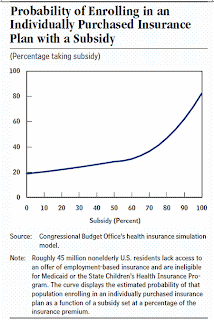
Put your economics hat on for a moment and entertain the CBOs proposition of federally-based subsidies for employers offering health insurance to their employees:

Changes in Subsidies for Employment-Based Insurance.
For several reasons, large employers are more likely than small employers to offer health insurance. Reflecting that fact, the response of firms to changes in the subsidies for employment-based insurance would depend not only on the impact of those changes on the net price of insurance but also on the size of their workforce. To estimate the likelihood that firms would offer (or drop) health insurance in response to a change in price, CBO multiplies the
average change in price for a firm’s employees by an “elasticity of offer”—a factor that measures how employers’ offers of insurance respond to changes in price. The elasticity of offer varies with the size of the firm and is based on estimates from several studies

For example, for firms with between 25 and 99 employees, CBO estimates the elasticity of offer to be -0.38; thus, a 10 percent increase in the premiums for firms of that size would cause a 4 percent decline in the number of employees offered coverage. Consistent with the available
evidence, the relevant “price” in that calculation is the total cost of insurance to the employer and employee combined—net of any federal (or state) subsidies
—not just the portion that the employer pays directly.
Consider, for example, how firms of different sizes would
respond to a subsidy proposal that reduced the net price of
employment-based insurance by 20 percent
. CBO
anticipates that such a subsidy would increase the availability
of health insurance at very small firms (those with
fewer than 25 employees) by about 23 percent (the
20 percent reduction in price multiplied by -1.14, the
elasticity of offer). The share of employees at such firms
that are currently offered insurance is estimated to be
48 percent, so the proposal would be expected to increase
that share by 23 percent, to 59 percent, or a gain of
3.4 million workers. Larger firms would be less responsive
to the subsidy, and analogous calculations for all
firms would yield an overall increase in the offer rate of
about 6 percent (an average elasticity of offer of -0.28
times -20 percent); that translates into an increase of about
6 million in the number of workers offered coverage,
roughly half of whom would have been uninsured
before receiving the new offer.

At the employee level, the report also discuss some "sticks" that can be used to incent employees to make more informed choices when selecting a health plan:

Some proposals would make consumers bear the cost of their health insurance more directly, either by paying the full cost themselves or by paying the added cost of more expensive policies. Proposals could achieve that goal by:
  • Reducing or eliminating the current tax subsidy for employment-based insurance, perhaps replacing it with a tax credit or some other fixed-dollar subsidy (discussed above); or
  • Establishing a managed competition system, in which a range of plans is offered and the employer’s or the government’s contribution to the premium is a fixed amount—for example, the premium of the average plan or the least expensive plan available—thus requiring consumers to pay the additional cost of more expensive plans.
Those approaches—taken separately or in combination— would provide stronger incentives for enrollees to weigh the expected benefits and costs of policies when making their decisions about purchasing insurance.

There's more meat in the report, but it does reveal the government's ability to influence change. The real commentary then, is whether or not the political parties on Capitol Hill can coalesce on a finding a solution together.

See, there is a ray of hope after all, but it will take all parties, Federal Government, State Government, Employers and employees to band together to make it work.

-JS

Wednesday, January 7, 2009

Why Single-Payer Health Reform is Not Viable

When it comes to health care reform in America, there is a relatively simple solution that will cover everyone's basic health care, control costs and save businesses, most people and the country a lot of money.
It's called a single-payer health plan, where the government collects taxes to finance national health insurance. The government, which is the "single payer," covers all citizens and pays the bills when they visit private (or public) doctors, hospitals and other facilities for medical care.

All would have basic coverage, regardless of whether they have a job, or where they work. Nobody gets billed for basic care. No-body goes broke because of medical bills.
Yet this option has been declared "off the table" by Sen. Max Baucus, D-Mont., who's among those leading the charge for health care reform in America.
Top Democrats who will be deciding policy in America in 2009, including Baucus and President-elect Barack Obama, say single-payer is "not politically feasible," because the public won't strongly support it.
What they really mean is that when it comes to health care reform, they don't want a political fight with some of the nation's most powerful financial interests, which have the resources and the motivation to turn public opinion against meaningful reforms.
These interests include the health insurance industry, pharmaceutical drug companies, some hospitals, highly paid medical specialists, medical suppliers and others who now profit handsomely from our current system - and who could no longer command those profits under a single-payer system or an alternative form of a national health plan.
---
Don't necessarily agree or disagree, but like it or not, lobbyists are here to stay.
-JS

Saturday, January 3, 2009

Today's Axiom: Healthy Habits = Healthy Premiums

The simple message is:
Healthy Habits = Healthy Individuals, and Healthy Individuals = Lower Premiums

We all know that health insurance premiums are out of step with wage increases:

And it has been proven through multiple studies, that employee behavior is the single largest determinant in health care decision-making:


But chew on this new study. It quantifies that employers who, "Aggressively support improvement in employee’s health and healthy behavior" have on average, 16% lower premiums than companies with, "Consistently less support for employee health and healthy behaviors."

3 Charts, 1 message. Engaging your employees when it comes to their health care does make a difference.

Spread the Health in 2009.

-JS